
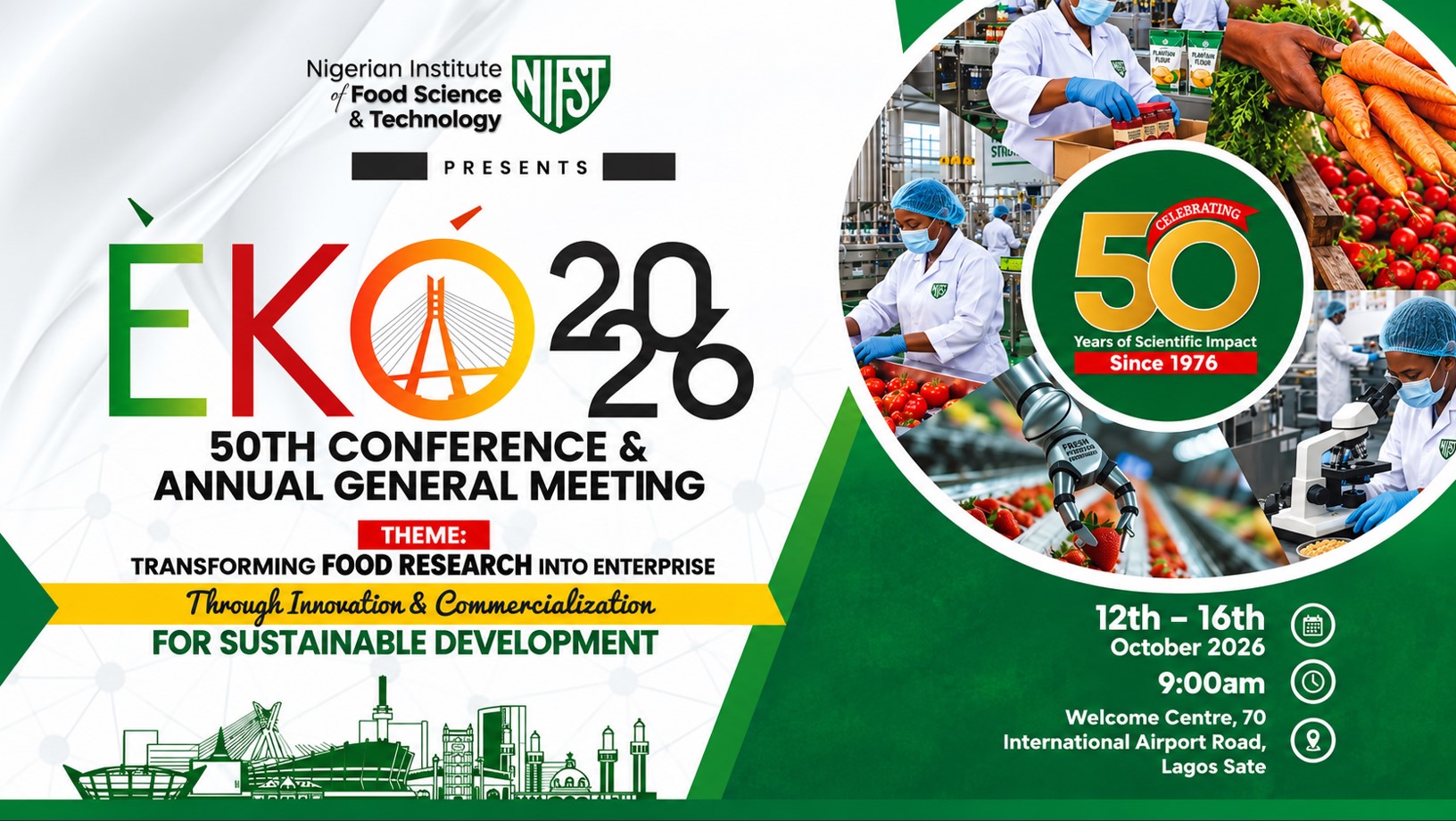
COMMUNIQUÉ ISSUED AT THE NIFST @50 NATIONAL CONFERENCE AND ANNUAL GENERAL MEETING
Theme: Transforming Food Research into Enterprise through Innovation and Commercialization for Sustainable Development
Date: 12–16 October 2026
Venue: Welcome Centre, 70 International Airport Road, Lagos State, Nigeria
1. PREAMBLE
The Nigerian Institute of Food Science and Technology (NIFST) convened its Golden Jubilee National Conference and Annual General Meeting from 12 to 16 October 2026 at the Welcome Centre, Lagos State, Nigeria, under the theme, “Transforming Food Research into Enterprise through Innovation and Commercialization for Sustainable Development.”
The conference attracted over 850 participants drawn from academia, industry, food regulatory agencies, government institutions and international organizations. It provided a distinguished platform for researchers, food scientists and technologists, entrepreneurs, policymakers, development partners and other stakeholders to explore strategies for translating scientific research into commercially viable innovations that advance food and nutrition security, public health, employment creation and sustainable development.
The conference featured the Prof. Mojisola Adeyeye, Director-General of the National Agency for Food and Drug Administration and Control (NAFDAC) as Special Guest of Honour; Mr Boye Olusanya, Group Managing Director/Chief Executive Officer of Flour Mills of Nigeria, as Conference Chairman; and Professor Lateef Sanni, FNIFST, Executive Director/Chief Executive Officer of the Nigerian Stored Products Research Institute (NSPRI), as Keynote Speaker.
Deliberations were enriched by 292 papers presented through oral and poster sessions, alongside eight panel discussions, a business forum, and exhibitions featuring products, innovations, and services from Small and Medium-sized Enterprises (SMEs) and major food companies. Key areas addressed included research commercialization, food enterprise financing, cassava industrialization, food safety, nutrition labelling, sustainable packaging, intellectual property, micronutrient analysis, circular food systems, and professional capacity development. These engagements provided a valuable platform for knowledge exchange, showcasing innovations, promoting business-to-business linkages, and strengthening collaboration among researchers, food industry players, entrepreneurs, regulatory agencies, and other stakeholders in the food system.
2. KEY OBSERVATIONS
Following the presentations and deliberations, the conference observed that:
- Nigeria possesses considerable research expertise, indigenous food resources and entrepreneurial potential, but many research outputs remain at the publication, prototype or pilot stage without progressing to sustainable commercial production.
- Weak academia–industry collaboration, inadequate funding, limited pilot scale facilities and insufficient market orientation constrain the translation of research into commercially viable enterprises.
- Food and agribusiness micro, small and medium enterprises face challenges in accessing affordable finance, meeting regulatory requirements, developing investment-ready proposals and gaining market access.
- Locally available agricultural resources, particularly cassava, offer opportunities for industrial development, value addition, employment generation and reduced dependence on imported raw materials.
- Food safety, appropriate packaging, reliable nutritional information and validated analytical methods are essential for consumer protection, product quality and market competitiveness.
- Food-processing by-products offer opportunities for circular enterprise development and resource recovery, provided that safety, quality assurance and regulatory requirements are met.
- Informal food markets require improved hygiene infrastructure, practical vendor education, effective waste management and sustained food safety monitoring.
- Digital innovation, intellectual-property management, industry-aligned training and professional mentorship are important for translating scientific knowledge into measurable economic and societal benefits.
3. RECOMMENDATIONS
The conference recommends the following priority actions:
3.1 Research Commercialization and Industry Collaboration
Universities and research institutes should strengthen industry-driven research, technology transfer, incubation and commercialization. Researchers should integrate market assessment, intellectual-property management and business planning, while NIFST facilitates partnerships among researchers, industry and investors.
3.2 Enterprise Financing and Local Industrialization
Government, financial institutions and development partners should improve access to finance for food enterprises, particularly MSMEs. Investment in cassava processing and other indigenous agricultural resources should be promoted through stronger value chains and improved infrastructure, energy and logistics.
3.3 Food Safety and Consumer Protection
Food safety education, surveillance, laboratory verification and consumer awareness should be strengthened. Food businesses should comply with relevant safety and quality standards, while proper labelling, hygienic handling and responsible health claims are promoted.
3.4 Nutrition, Micronutrient Analysis and Fortification
Nigeria should strengthen nutrition profiling, front-of-pack labelling, laboratory capacity and quality assurance. Food fortification monitoring, local premix development and consumer education should receive appropriate support.
3.5 Sustainable Packaging and Circular Food Systems
Sustainable, affordable and safe packaging solutions should be promoted alongside local packaging capacity, recycling and material efficiency. Food processing by-products should be explored for safe, value-added applications.
3.6 Digital Innovation and Intellectual Property
Collaboration should advance digital food safety reporting, effective intellectual-property management and support for emerging innovators. New products and scientific claims should undergo appropriate validation, safety assessment and regulatory compliance.
3.7 Professional Capacity Development
Academic institutions, food manufacturers and NIFST should expand practical training, industrial placements, mentorship and professional development. Indigenous foods and plant-derived innovations should be scientifically validated and standardized before health claims are promoted.
4. IMPLEMENTATION AND FOLLOW-UP
Subject to formal approval, the NIFST Governing Council should coordinate an implementation framework specifying priority actions, responsible stakeholders, measurable outcomes and timelines. Relevant committees, chapters and partners should facilitate collaboration and monitor progress in commercialization, food safety, enterprise development, professional training and sustainable innovation. Progress reports may be presented at subsequent National Conferences and Annual General Meetings.
5. APPRECIATION
The conference acknowledges the contributions of NIFST’s founding members, past and present leaders, Fellows, members and partners to five decades of professional service. Appreciation is extended to the Special Guest of Honour, Conference Chairman, Keynote Speaker, organizing committees, speakers, moderators, rapporteurs, exhibitors, sponsors, institutional partners, volunteers and participants whose contributions ensured the success of the Golden Jubilee conference.
6. CONCLUSION
The NIFST @50 National Conference and Annual General Meeting emphasizes that food research achieves its greatest impact when translated into safe, affordable, market-relevant and commercially viable products, processes and services.
As the Institute celebrates five decades of professional service, the conference calls for stronger collaboration among academia, industry, government and regulators to accelerate innovation, enhance food and nutrition security, protect consumers, create employment and promote sustainability. The Golden Jubilee offers an opportunity to build on past achievements and strengthen the contribution of food science and technology to Nigeria’s industrial development, national prosperity and improved quality of life.
Issued at: Welcome Centre, 70 International Airport Road, Lagos State, Nigeria.
Date of adoption: 15th October, 2026.
SIGNATORIES
National President, NIFST
Name: Chief Dr. Ignatius Alaka
National Secretary, NIFST
Name: Mr Rasaq Oke
Chairperson, Communiqué Committee
Name: Dr Tolulope Ibukun Ojo


0 Comments